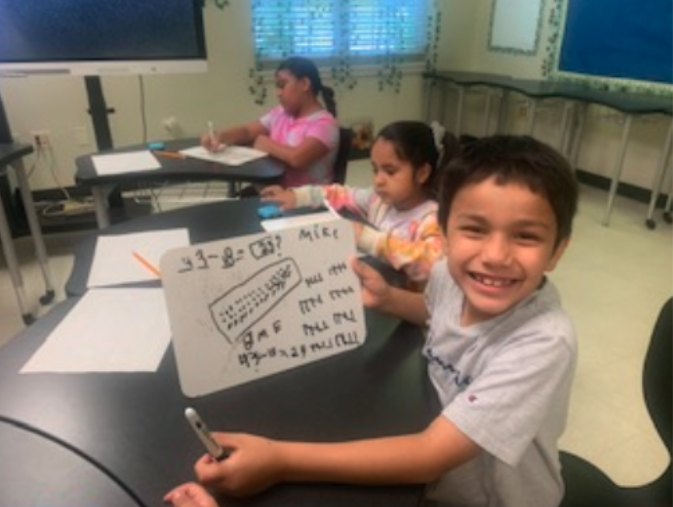
Beyond the Classroom
Instructional leaders understand the complexity of teaching and the meticulous attention it demands. Observing student engagement through smiles and raised hands provides some helpful, yet superficial insights.
The critical question is: Are our teaching strategies fostering real understanding?
Ambrosia Johnson, an Instructional Consultant and Institute Lead at Lavinia Group, works with schools to implement data-driven student work-study.
This approach allows educators to dive deep into student work, identifying specific areas of misunderstanding to tailor teaching strategies effectively. Using concrete evidence to align instruction with each student's needs, teachers can quickly improve learning outcomes.
For school leaders aiming to elevate educational standards, adopting student work-study is an accelerated learning strategy that both measures and swiftly improves learning comprehension.
How Student Work-Study Identifies Transferable Takeaways
Student work-study is a methodical approach to examining student work, identifying key learning gaps and common misunderstandings. This analysis provides a foundation for educators to refine teaching strategies.
“It's a time where you have a student work product in front of you, and you can spend the time really diving into it to analyze what we have, where students are, and where we need to go,” explains Johnson.
A rubric helps teachers look at student work in a structured way. “Say this is level two, this is level one, this is level zero. Now, I have three different piles of work. Say I notice that my students are struggling with X. When I see them again, I am going to turn X into something transferable that they can then use so that whatever my results were on Monday, they’ll look different on Wednesday. The highest-leverage learning gap is critical because it is going to then dictate my takeaway in subsequent lessons.”
Student work-study allows teachers to tailor lesson plans for the whole class and adapt instruction for targeted small groups. This approach ensures every student has the chance to advance, from high achievers to students with learning gaps.
As Johnson points out, small-group intervention works best when students feel they’ve been selected for a special project rather than as a response to shortcomings.
She notes, "Student work-study allows us to gather precise insights into student progress. With my tracker of notes, and as I go to each student’s desk, and provide targeted prompts, addressing specific needs directly."
Accelerating Learning Through Student Work Study
Detailed analysis of student work offers educators a window into the minds of their learners, revealing not just what students know, but how they think.
Armed with insights from student work, teachers can customize their instructional approaches to better match the learning styles and needs of each student. This personalized teaching strategy not only makes learning more accessible but also more engaging.
Analyzing student work often highlights students' abilities to apply concepts in problem-solving situations. Teachers can use this information to design activities that challenge students to think critically, analyze data, and apply knowledge in new contexts. This deepens understanding and fosters higher-order thinking skills.
Immediate feedback derived from student work study is invaluable. Teachers can address learning gaps in real-time, providing students with the guidance they need to build on their individual knowledge effectively. These feedback loops support a dynamic learning process where students continuously improve and advance.
Integrating Student Work-Study Into Our Schools
For educators unfamiliar with the practice of student work-study or unsure how to make time for it, Johnson encourages them to think of it as an extension of a professional learning community: “A lot of my schools have PLCs built into their schedules, and some of them just use it for work-study.”
Student work-study provides valuable insights for teachers. Instructional leaders can also utilize student work-study to support enhancing teaching strategies.
Often within the framework of intellectual preparation meetings "we might begin with examining student work. 'Show me the work you've categorized as level one. What patterns do we see? How do you plan to address this? What key lesson can we draw from this for future teaching?' Such discussions can guide our teaching strategies," explains Johnson.
Recognizing that data interpretation and instructional planning vary among teachers, this method facilitates lesson planning discussions. Student work-study sessions help keep track of student progress, offering a clearer understanding of each student's challenges and how they respond to specific interventions.
Johnson suggests viewing student work-study as part of a broader professional learning community effort, noting that many schools already incorporate it into their Professional Learning Communities (PLCs) schedule.
Educators who look at student work in a collaborative process hope to learn about the effectiveness of their instruction, better understand students’ learning and development, develop more effective curriculum and assessment, and help students do higher quality work says David Allen, a researcher at Harvard Project Zero and one of the authors of the book Looking Together at Student Work: A Companion Guide to Assessing Student Learning.
For new teachers, integrating student work-study with lesson planning as teachers become more familiar with their curriculum is key, shared Johnson. Student work-study meetings make it easier to track the data collected, helping to maintain an up-to-date picture of student performance and the reasons for it, seeing students as individuals rather than statistics.
Analyzing student work makes it easier to follow individual struggles with the lesson and respond with targeted instruction. By making student work-study an intentional, building-wide practice, school leaders are better equipped to support teachers in reaching and teaching every student.